The Spatial Web Just Got a Browser. Your AI Still Needs a Runtime.
June 2026 was the month the spatial web stopped being a pitch deck. At AWE in Long Beach, RP1 and the Metaverse Standards Forum announced Sneeze, an open source browser engine for 3D space, pitched as what Blink is to the 2D web. Snap opened preorders on Specs, standalone AR glasses at $2,195. And Niantic pointed its Scaniverse community at urban infrastructure and industrial environments with a Gaussian splat challenge judged partly on practical value.
Three different companies, one message. Spatial content is becoming something you publish, browse, and put to work, the way you do a website.
We think that is great news.
The question a browser doesn’t answer
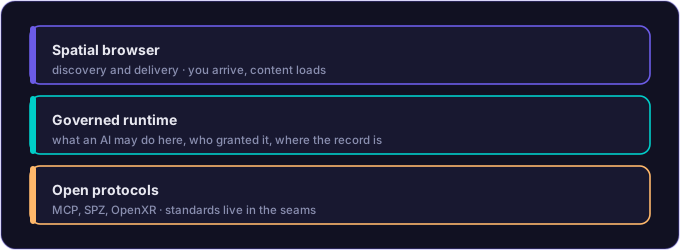
A browser engine solves discovery and delivery. You arrive in a space and the content loads. What it does not answer is the question that shows up the moment an AI agent walks in with you: what is this agent allowed to do here, who granted that, and where is the record?
That question is RakuAI’s whole job. The runtime exposes a spatial world to any AI assistant through 17 native MCP tools. The 5 read-only tools work everywhere. The 12 tools that can change the world are deny-by-default: in production, mutation happens only under an explicit, audited permission grant, and every call lands in a per-session audit trail. Claude, ChatGPT, Gemini, and Copilot all drive the same contract, so none of them gets a special door.
The browser opens the space. The runtime governs what your AI can do inside it. Both layers have to exist, and the more open the first one gets, the more the second one matters.
Open at the protocol layer
Our engine is proprietary and we are not going to pretend otherwise. Our openness lives where interoperability actually happens, in the protocols:
- MCP is an open protocol. Any model from any vendor speaks it, and our runtime has been speaking it in production since March 2026.
- SPZ is Niantic’s open Gaussian splat format, and it is what our capture pipeline outputs. A splat scanned with our capture flow and a splat from the wider ecosystem live in the same format.
- OpenXR is where our display and tracking layer meets the hardware.
Standards belong in the protocols. Engines should compete on quality. That is how the 2D web worked, and it is the posture we are keeping as the 3D one takes shape.
The MCP spatial tool contract
The piece teams keep asking about is the contract itself: the versioned definition of all 17 tools, the schema for each, the permission and audit semantics behind every call, error behavior, and the rules we follow when the contract changes.
We share the full contract with teams that are evaluating an integration. Tell us what you are building and we will send it over: request the MCP spatial tool contract.
The part only we do end to end
Point a phone at a room and you get a scene. Connect an assistant over MCP and that scene becomes a place your AI can query, measure, and act in, under rules you set, with a log you can read. Capture to governed agency, one pipeline.
The spatial web getting a real browser is the strongest signal yet that this layer was worth building. Welcome to the open spatial web. Bring your AI.