The Framework Era Is Over. The Bottleneck Moved to Delivery.
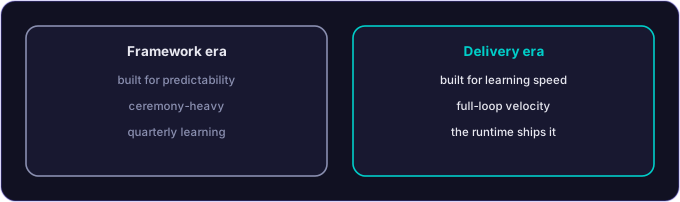
Jeff Gothelf put it bluntly: SAFe was “architected deliberately to produce predictability and coordination at scale. That was the right answer to the problem it was solving. The problem now is different.” He’s right, and the market agrees — scaled-agile frameworks are in open backlash, agile-coach roles are being eliminated, and enterprises now ask for help that is explicitly framework-agnostic.
But “stop using frameworks” is only half an answer. Here’s the other half, and it’s the part most of the post-agile takes skip.
AI didn’t speed up the loop evenly. It moved the bottleneck.
Every product organization runs the same loop: discover → build → deliver. AI compressed two of those three, hard.
- Discover — design thinking, user research, journey mapping, prototyping. A prototype that took weeks now takes hours; whole flows are generated in minutes. Discovery is faster than it has ever been.
- Build — code generation collapsed the time from spec to working software.
- Deliver — deployment, integration, testing, governance, and change management through large, real systems. AI barely touched this.
So the constraint moved. When you accelerate discovery and build but not delivery, you don’t get a faster company — you get a faster idea factory feeding the same slow pipe, and a growing pile of validated ideas stuck against the delivery wall. Anyone who has shipped inside a large enterprise has watched this happen.
This is why “learn faster” is an incomplete thesis. Learning rate is necessary, but the organization that wins is the one with the shortest path from a validated insight to delivered, governed value in production. Call it full-loop velocity. It’s the honest version of the adaptive advantage everyone is chasing: you don’t win because AI made you cheaper — cost-led AI is exactly what failed at the companies that mandated it. You win because you out-learn and out-ship competitors still planning in quarters.
A runtime compresses delivery. A framework can’t.
A framework is a plan. It coordinates people; it does not execute software. You cannot shorten delivery by adopting a heavier operating model — that’s adding ceremony to the exact step that’s already the bottleneck.
What compresses delivery is a runtime: an execution layer that’s already deployed, already governed, already in production, so a new insight drives real value through the system without rebuilding the plumbing every time. That is what RakuAI is — the AI-native spatial runtime that lets any assistant (Claude, ChatGPT, Gemini, Copilot) act on the real world through a deny-by-default, audit-logged, multi-vendor MCP surface. Not a methodology to roll out. A system that runs.
It also collapses the false choice between committing to delivery and staying free to pivot. When delivery is cheap and reversible, you can commit early and change course in week three, because shipping the corrected version is fast. Gothelf’s “say it’s wrong and pivot” stops being a culture slogan and becomes an economic fact — a consequence of short delivery time, not a poster on the wall.
How it works — three moves, not a framework
- Map — the journey and where value hides. Experience design at the front, where it belongs, now compressed by AI.
- Ground — anchor in real context (a real captured space, real data) so the AI acts on truth, not a prompt. This is the step that keeps speed from turning into confident, wrong output.
- Run — drive it through the runtime: governed, audited, in production. Govern and scale live here.
Three moves an executive can remember, attached to a system that executes them — not a thirty-box wall chart and a certification path.
The takeaway
The framework era solved the old problem: predictability at scale. The new problem is the opposite — adaptiveness at speed, where the binding constraint is delivery, not planning. The fix isn’t a bigger framework with an AI layer bolted on top. It’s subtraction plus a runtime: fewer moves, and an execution layer that turns fast learning into fast, governed delivery.
Stop adopting frameworks. Start measuring full-loop velocity. And put the runtime where the bottleneck actually is.