How Four Programs Power the Compute Behind Raku Capture
Raku Capture looks simple from the outside. You walk a room with your phone, and a few minutes later there is a 3D Gaussian splat of that room that an AI assistant can measure and act in over MCP. Under that simplicity sits a pipeline that wants serious GPU compute at more than one layer.
We are a bootstrapped startup in Washington State. We did not raise a round to buy that compute. What we did instead was join the startup programs that the big platforms run, and it turned out that each one was useful in a different place. No single program carried the whole thing. Each removed one bottleneck at one layer of the stack, and the layers add up to a working product.
We want to be careful with the framing here. We would have found another path through every one of these layers eventually. Startups always do. The honest claim is smaller and still worth writing down. These programs let us move through the layers in months instead of quarters, and they let us do it without giving up equity or focus.
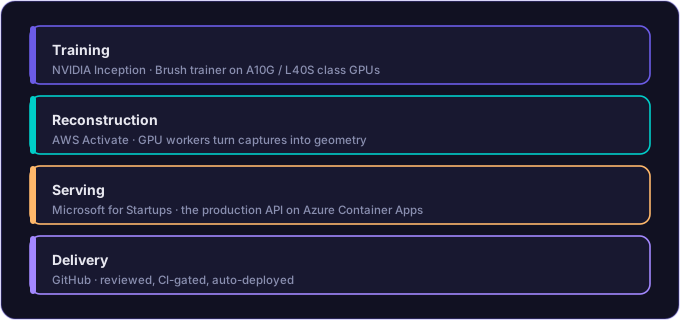
Here is the stack, layer by layer.
 NVIDIA Inception, the training layer
The heart of the pipeline is splat training. A capture session produces a stream of posed images, and a trainer turns those images into a 3D Gaussian splat. We train with Brush, an open source splatting trainer, on A10G and L40S class GPUs.
We joined NVIDIA Inception in May 2026. The program gives us the NGC catalog, which is where our hardened CUDA container images come from, and the Deep Learning Institute, which is how a small company keeps its GPU skills current without a training budget. It also put us inside an ecosystem where the people building the next generation of vision hardware can find us.
Training quality is the product. When the splat is crisp, everything downstream feels like magic. When it is mushy, nothing downstream can save it. Inception sits under the layer we care most about.
 AWS Activate, the reconstruction layer
Before anything can be trained, the raw capture has to become geometry. A GPU worker picks up the uploaded frames and solves the camera poses with structure from motion. It then runs the training pass and packages the result as an SPZ file the viewer can stream.
Those reconstruction workers run on AWS G5 instances, which carry the same A10G GPU class we train against. We are an AWS Activate participant, and Activate is what made it reasonable for a bootstrapped company to keep real GPU capacity a queue message away instead of a procurement cycle away.
This is the layer where robot vision work lives too. The same reconstruction path that handles a living room handles a warehouse aisle or a factory cell, and the output is a metric scene a robot planner or an inspection workflow can consume.
Microsoft for Startups, the serving layer
Everything above produces artifacts. Something still has to serve them. The production API that phones and AI assistants talk to runs on Azure Container Apps, next to our database and object storage. Every capture upload and every MCP tool call lands there first.
RakuAI is a member of Microsoft for Startups, and Azure credits from the program carry that serving layer. Serving is the least glamorous part of the stack and the part users feel most directly. When the API is slow, the product is slow, no matter how good the splat is.
GitHub, the delivery layer
The last layer is how any of this ships. Every change to the platform, from the engine to this website, moves through GitHub. Automated reviewers comment on every pull request within minutes. A merge to main deploys to production without a human touching a server, and the site you are reading is served by GitHub Pages.
For a tiny team, that delivery loop is the difference between shipping daily and shipping monthly. It is also what makes it safe to let AI agents do real engineering work here, because every change goes through the same reviewed and revertable path.
Why the layer framing matters
It would make a better story to say that any one of these programs saved the company. It would not be true. What is true is that a spatial capture stack has distinct layers, and a bottleneck at any layer throttles the whole pipeline. Training capacity without a serving layer is a demo. A serving layer with no delivery loop is a liability. The useful thing about this set of programs is that they happened to line up one per layer.
The same stack serves two futures at once. On the enterprise side it is robot vision, where captured facilities become scenes that planners and inspection tools can reason over. On the consumer side it is smart glasses and simulation worlds, with the spatial engine sitting under both. The layers do not change between those futures. Only the scale does.
If you are a founder staring at a GPU shaped hole in your plan, the practical advice is to stop thinking of these programs as one pool of generic credits. Map your stack first. Then match each program to the layer where it actually helps.
Programs
Program notes
NVIDIA Inception is a free program for AI startups. RakuAI’s membership does not imply that NVIDIA endorses RakuAI’s products. “AWS” and “AWS Activate” are trademarks of Amazon.com, Inc. or its affiliates. RakuAI’s participation does not imply that AWS endorses RakuAI’s products. Microsoft, Azure and Microsoft for Startups are trademarks of the Microsoft group of companies. RakuAI’s participation does not imply that Microsoft endorses RakuAI’s products. GitHub is a trademark of GitHub, Inc. RakuAI’s use of GitHub does not imply that GitHub endorses RakuAI’s products.