PlayRoom
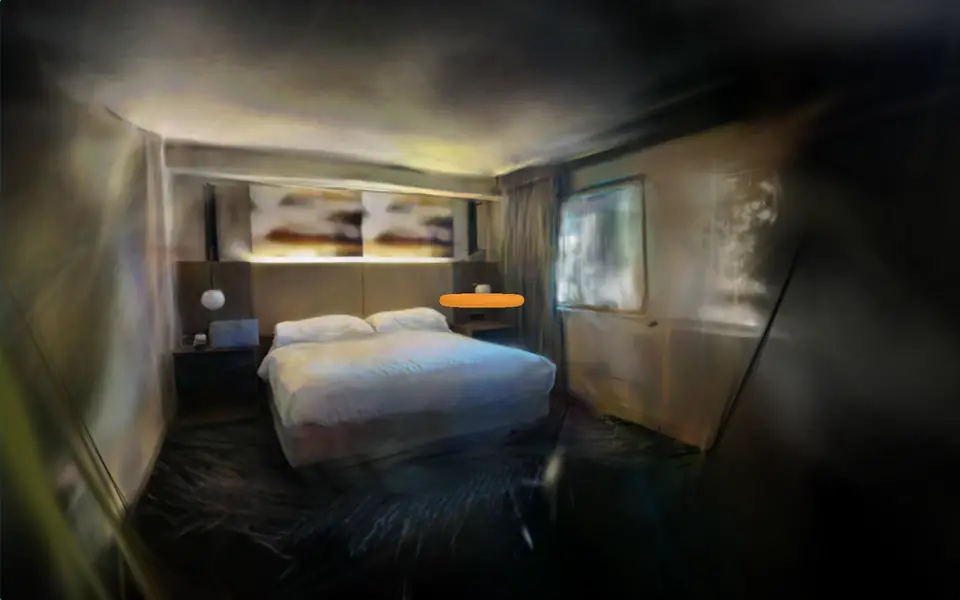
Step inside a real phone-captured room, rendered live on your own GPU. Move and look with the keyboard, mouse or a gamepad, and shoot hoops that collide with the real captured furniture and floor. What you feel is computed in this tab (the browser reference tier). With a developer key, the LIVE ENGINE panel runs spatial queries on a real capture through the RakuAI engine’s native routes on api.rakuai.com and shows every raw call. Each panel says which of these you are looking at.
Watch AI change a simulated world—and remember
An AI previews two actions in a physics engine, chooses one and says why, waits for a person to approve it, runs it, and the world remembers the result for the next visitor. This is a recording of one accepted run, replayed exactly: no AI or engine runs now.
Starting the showcase…
WHAT IS REAL HERE
- REAL The room is a real phone capture, reconstructed by COLMAP structure-from-motion and trained by Brush on an NVIDIA A10G in the RakuAI pipeline, stored as a gzip-framed SPZ splat and rendered straight off your own GPU.
- CLIENT The render, the camera, your input, the ball flight and the arcade collision you feel are computed in this tab, for responsiveness. This is the browser reference tier, not the native C++ engine. If your browser cannot read the splat's positions, the HUD says so rather than pretending a collision grid exists.
- SERVER With a developer key, the LIVE ENGINE panel asks the engine’s native splat routes on api.rakuai.com to build a voxel grid from a real capture, segment objects and resolve a sphere-drop, streaming every raw request and response. If the server does not have the native library loaded, those routes refuse (HTTP 501) instead of returning a result, and the panel shows the refusal. Any numbers there come from the server, not this page.
- HONEST UNKNOWN This capture has no semantic object labels (its frames were discarded after reconstruction, so there is nothing to label from) and no resolved metric scale. The engine returns an honest 501 for labels and reports scene units, and this demo shows objects as unlabeled geometry, never an invented name or dimension.
- GATED Driving THIS room from an LLM over MCP is the flagship
and it is gated on a security fix to
mcp.rakuai.complus a live credential. Until that lands, the DIRECTOR shows the exact tool call an agent would make and refuses to fake a result. The SERVER tier below already proves a real server tool loop responding today. - SOURCE The SIMULATION SOURCE toggle switches the stage between
the browser reference arcade and native-result playback. In playback one marker moves only to
positions a
raku-ces-simulation/0envelope returned, through a fixed, documented x0.5 display transform (a presentation choice, not a metric scale). The stage badge reads BROWSER REFERENCE, REPLAY or the native engine label, and shows NO RESULT for anything invalid, stale, unprovenanced or not produced by the engine. The bundled envelopes are a hand-written synthetic contract fixture, shown as REPLAY, and one real RakuPhysics envelope (ball and barrier, pinned to its file hash, fixture digest and engine binary hash) carrying 90 engine-read ball samples, one every 2 steps, plus the final state at step 180. The marker holds each returned sample until the next one; the viewer never interpolates or invents frames. The trail line and the identity orientation are viewer drawing choices, and the axis mapping is the viewer's own declaration, because the engine reports no handedness and no rotation.
OBJECTIVE arcade
SIMULATION SOURCE what moves the object
mint-test-user prints one) and saves a run only for the user who launched it, so sign in before Launch.
The token is held in this page's memory only: it is never stored or exported, and Leave forgets it, so paste it again to Return.LIVE ENGINE native routes on api.rakuai.com · key required
raku_ developer key to call the engine’s native routes on a real capture. The
key stays in this tab only: never stored, never logged, never shown in the feed. Leave it empty
and the demo still fully plays client-side.